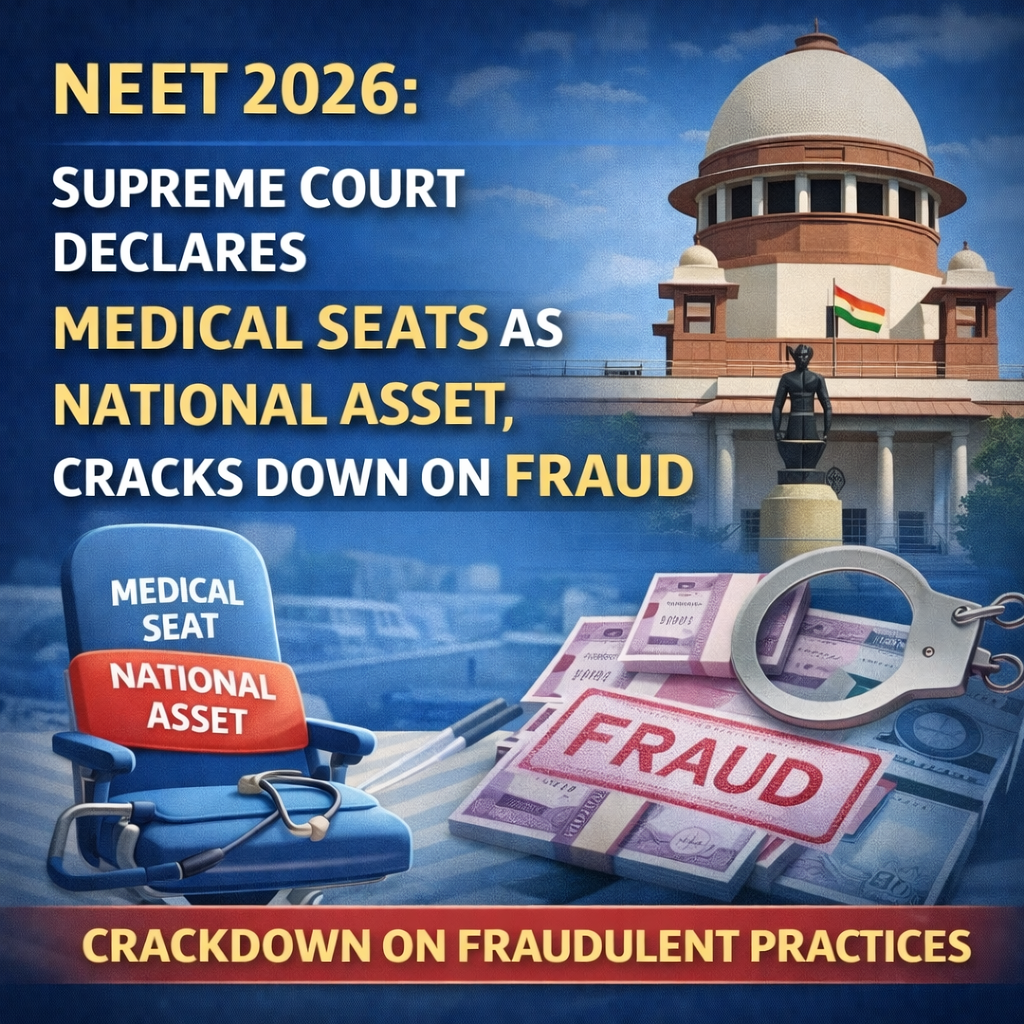
On 11 April 2026, the apex court emphasised that every MBBS and postgraduate seat represents years of public investment, taxpayer money and the future of healthcare in the country. Leaving even a single seat vacant due to malpractice, irregularities or procedural delays is simply unacceptable.
What Triggered the Supreme Court’s Strong Remarks?
The case revolves around alleged irregularities in the NEET UG examination and subsequent counselling process. Multiple petitions reached the Supreme Court highlighting instances of paper leaks, impersonation and manipulation of seat allotment that ultimately led to seats remaining unfilled even after the mop up rounds.
The bench while hearing the matter observed:
“Medical seats are a national resource. They cannot be left vacant.”
This single line has now become the guiding principle for all future NEET related disputes. Court made it crystal clear that the right to a medical seat is not a private privilege but a public asset that must be utilised to serve the nation’s healthcare needs.
Why This Ruling Matters for Every NEET Aspirant
For the lakhs of students who appear for NEET every year, this verdict is both reassuring and challenging:
Positive Side:
- It strengthens the demand for absolute transparency in the examination and counselling process.
- It puts pressure on authorities to complete seat allotment rounds efficiently so that no seat goes waste.
- It reinforces merit as the only criteria for admission, discouraging backdoor entries.
The Tough Reality:
- Students who relied on “management quota” or dubious methods now face stricter scrutiny.
- State counselling bodies will be held more accountable for timely and fair seat filling.
- Any future proven fraud could lead to stricter penalties and possible cancellation of entire counselling rounds.
The Bigger Picture: India’s Doctor Shortage vs. Vacant Seats
India continues to face a paradoxical situation. On one hand, we have a massive shortage of doctors in rural and underserved areas. On the other, every year thousands of medical seats remain vacant after counselling sometimes due to high fees, sometimes due to counselling delays, and sometimes due to fraudulent activities.
Supreme Court’s observation directly addresses this mismatch. By calling medical seats a “national resource,” the judiciary has reminded everyone that these seats are not just for individual careers but for the larger goal of strengthening India’s healthcare system.
What Changes Can We Expect Now?
Experts believe this ruling will fast-track several reforms:
- Faster counselling timelines– All rounds including stray vacancy rounds must be completed quickly.
- Stricter monitoring of exam centres– With advanced AI based proctoring and biometric checks likely to become standard.
- Uniform counselling policies– Reducing discrepancies between All India Quota and state quotas.
- Heavy penalties for fraud– The Court has signalled zero tolerance for anyone who tampers with this national resource.
A Wake Up Call for Coaching Industry and Parents
The NEET coaching industry which has grown into a multi thousand crore business is also under the scanner.Supreme Court has repeatedly warned against commercialisation of medical education. Parents and students must now think twice before falling for “guaranteed seat” promises that often turn out to be fraudulent.
The message is loud and clear: Merit matters. Hard work matters. Shortcuts will be punished.
Final Thoughts: A New Era for Medical Education in India
The Supreme Court’s verdict is not just about one fraud case. It is a foundational statement that will guide medical admissions for years to come. By declaring medical seats as a national resource, the Court has placed the future of India’s healthcare above individual or institutional interests.
For genuine NEET aspirants who burn the midnight oil, this is validation that their efforts will be protected. For the system, it is a warning that efficiency, integrity, and transparency are no longer optional they are mandatory.
As the nation waits for the final judgment and detailed guidelines, one thing is certain: the era of treating medical seats as private property is over. They belong to India and India cannot afford to let even one of them go waste.
What are your thoughts on the Supreme Court’s ruling? Do you believe this will finally bring lasting reforms to the NEET system? Share your views in the comments below.