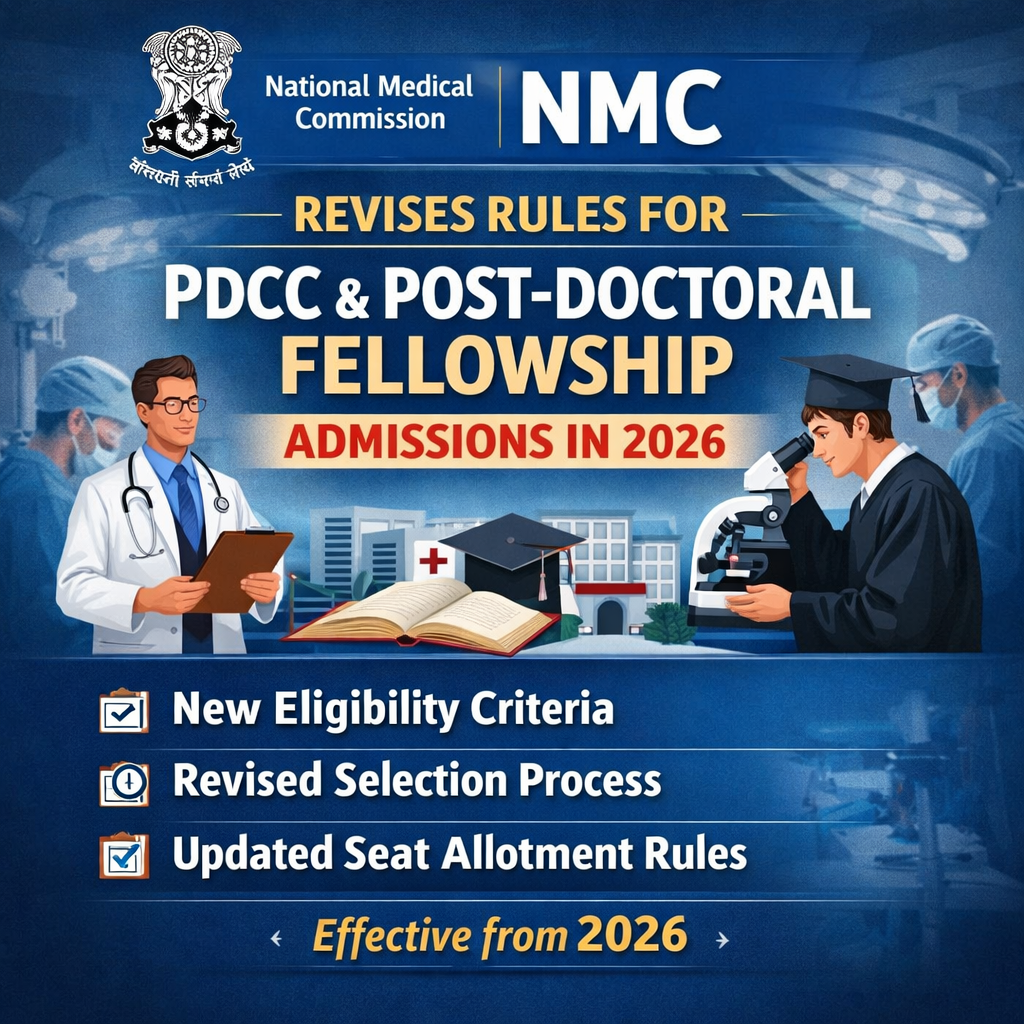
On April 12, 2026 Medical Dialogues reported that the Postgraduate Medical Education Board (PGMEB) of the NMC has amended the Post Graduate Minimum Standards of Requirements (PGMSR 2023). The new rules bring much needed clarity on how many Post Doctoral Certificate Course (PDCC) or Post Doctoral Fellowship (PDF) students a college can admit every year.
These programs are now officially allowed over and above the existing sanctioned seats a move that could open more doors for doctors seeking focused, short term advanced training without competing for limited super specialty DM/MCh seats.
What Are PDCC and Post-Doctoral Fellowship (PDF) Programs?
Before diving into the new rules, let’s quickly understand the difference:
- Post Doctoral Certificate Course (PDCC): A 1 year focused certificate program designed for doctors who have completed MD/MS/DNB. It targets highly specific skills in niche areas such as critical care, interventional radiology, transplant immunology, or advanced endoscopy. PDCC is ideal for doctors who want quick, practical upskilling.
- Post Doctoral Fellowship (PDF): Usually a 1–2 year program that offers deeper research and clinical exposure in emerging or sub specialty fields. It is often more academic or procedure oriented and is highly valued for career growth in teaching hospitals or specialized centers.
Both programs help bridge the gap between broad specialty training and ultra-specialized practice and they’re now getting standardized nationwide.
The New NMC Rules for PDCC and PDF Admissions (2026 Onwards)
According to the latest amendment to PGMSR 2023, here’s exactly how medical colleges can offer these additional seats:
For departments that follow a Unit structure:
- A college can admit either 1 PDCC student OR 1 PDF student per unit per year.
- These seats are over and above the already approved or eligible seats in that unit.
For departments that do NOT follow a Unit structure:
- Colleges can admit 1 PDCC or 1 PDF student per year for every 5 sanctioned or eligible seatsin the department.
- Again, these are extra seats.
Key highlights:
- The college must choose either PDCC or PDF not both in the same unit/year.
- If there are leftover vacancies after regular PG admissions, colleges can still fill the PDCC/PDF slots.
- All institutions must comply with these updated standards immediately.
This is a significant shift from the earlier ambiguous guidelines and brings uniformity across government and private medical colleges.
Why Did NMC Make These Changes?
The PGMEB’s goal is simple: improve the quality of post graduate medical education while expanding opportunities for advanced training.
Previously, many colleges offered PDCC/PDF seats informally or without clear norms, leading to confusion during inspections and seat allocation. The new rules:
- Standardize intake capacity
- Ensure adequate faculty, infrastructure, and patient load
- Encourage colleges to invest in niche training programs
- Help reduce the pressure on limited DM/MCh seats
For aspiring doctors, this means more structured and recognized pathways for career advancement.
Who Will Benefit the Most?
For Medical Students and Young Doctors:
- More seats in high demand areas without waiting for NEET-SS
- Opportunity to gain specialized skills faster
- Better chances of placement in corporate hospitals, research centers or abroad
For Medical Colleges and Faculty:
- Clear norms for starting or expanding PDCC/PDF programs
- Ability to utilize existing infrastructure more efficiently
- Stronger academic profile during NMC inspections and rankings
What Should You Do Next?
If you’re a doctor planning advanced training:
- Check the official NMC website and your preferred college’s website for PDCC/PDF notifications.
- Keep an eye on NEET SS counseling rounds and state level admissions.
- Prepare your documents early most programs require MD/MS degree, registration certificate, and sometimes a research proposal.
If you’re a medical college administrator:
- Review your department wise unit structure and sanctioned seats.
- Align your 2026–27 admission process with the new PGMSR 2023 amendments.
- Update your website and prospectus accordingly.
Frequently Asked Questions (FAQs)
Q1. Are these PDCC/PDF seats part of regular NEET SS counseling?
No. Most PDCC and PDF programs are conducted at the institutional level or through separate notifications by the college/NBE.
Q2. Can a college offer both PDCC and PDF in the same department?
Only one type per unit per year. The college has to choose either PDCC or PDF.
Q3. When do the new rules come into effect?
Immediately, as per the PGMEB public notice.
Q4. Will this increase the total number of post doctoral seats in India?
Yes colleges can now formally add these extra seats without affecting their existing PG intake.
Final Thoughts
The NMC’s 2026 revision is a welcome step toward making advanced medical training more accessible, transparent, and standardized. Whether you’re a fresh MD/MS graduate looking for specialized skills or a medical college striving to enhance its academic offerings, these changes create real opportunities.
Stay updated by regularly checking the official NMC portal (nmc.org.in) and reliable medical news sources.
Have questions about how these rules will affect your college or career? Drop them in the comments below I’ll try to answer as many as possible!
Share this post with your batchmates and colleagues who are planning super-specialty or fellowship training. Knowledge like this travels fast in the medical community!