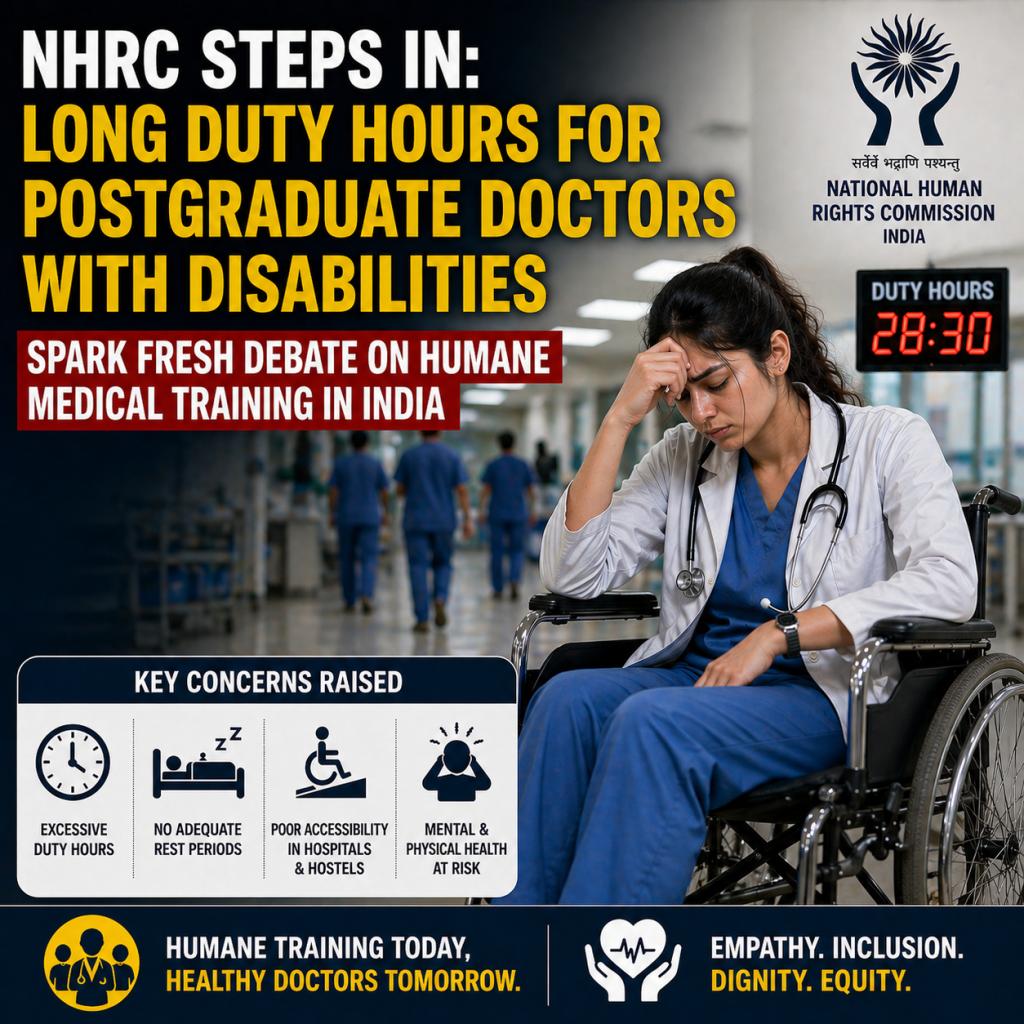
If you’re a medical student, resident doctor or someone who cares about the people who keep our hospitals running, this story might hit close to home. For years tales of exhausted postgraduate (PG) residents working marathon shifts have circulated in medical circles. Now National Human Rights Commission (NHRC) has officially taken notice specifically highlighting the extra burden on students who are persons with disabilities (PwD).
On April 24, 2026 NHRC acted on a complaint from Dr. Lakshya Mittal, Chairperson of the United Doctors Front (UDF), Commission has asked National Medical Commission (NMC) and the Union Ministry of Health and Family Welfare to investigate and report back within two weeks. Issue is simple but serious: are 24- to 72 hour nonstop duties compatible with basic human rights especially for doctors already navigating disabilities?
This isn’t just another policy notice. It shines a light on a system that’s been straining young doctors for decades and raises practical questions about how we train our future physicians without breaking them in the process.
Complaint That Got the Ball Rolling
Dr. Mittal’s complaint originally filed in July 2025 paints a stark picture. Postgraduate medical students particularly those in the PwD category are often expected to work continuous stretches of 24 to 36 hours, sometimes stretching to 72 hours. These long hauls, complaint argues directly violate older guidelines like the Uniform Central Residency Scheme of 1992 and the more recent Postgraduate Medical Education Regulations (PGMER) 2023 from the NMC.
UDF pointed out that despite clear provisions for reasonable working hours, weekly off days and proper rest, many medical colleges simply ignore them. complaint also highlighted how this setup hits PwD students harder. They may need extra time for mobility aids, medication, therapy or simply managing fatigue from a condition that isn’t immediately visible to colleagues or supervisors without “reasonable accommodation” a key principle under the Rights of Persons with Disabilities Act, 2016 these students face added physical strain, subtle discrimination and fewer support systems.
NHRC agreed the allegations were serious enough to warrant action, calling them potential violations of human rights, including the right to life with dignity and just working conditions.
Why PG Residency Feels Like an Endurance Test
To understand the fuss, let’s step back and look at how PG training actually works in most Indian medical colleges. After finishing MBBS, doctors who clear NEET PG enter three-year specialty programs (MD, MS or DM). They’re called residents or junior residents and they’re the backbone of teaching hospitals. During the day, they attend rounds, see patients, assist in surgeries, manage emergencies and handle paperwork, At night? Many stay on call.
Patient loads in government and even some private hospitals are huge. One resident might handle dozens of cases in a single shift. Add to that teaching duties, thesis work, exams and the schedule quickly fills up, the result? Shifts that blur into the next day and sometimes the one after that.
This isn’t new, the 1992 residency scheme from the Health Ministry aimed for something more balanced: roughly 48 hours a week with built in rest. The 2023 NMC guidelines talk about “reasonable working hours” and time for rest but they leave room for institutions to interpret that based on local needs like patient volume and staffing shortages.
A 2024 NMC National Task Force on medical student mental health echoed the concerns. It found long 24 hour duties as a major contributor to stress, burnout, dropouts and even suicides among PG students. The task force suggested practical limits where possible no more than 74 hours per week, no single stretch longer than 24 hours and at least one full day off weekly. Yet enforcement remains patchy. Many residents quietly accept it as “part of the training.” Others burn out or leave.
Extra Layer of Difficulty for PwD Residents
Imagine this real life scenario (drawn from common experiences shared by doctors in similar situations): Dr. Priya (name changed) has a locomotor disability that requires her to use crutches or a wheelchair for longer distances. She’s a bright PG resident in internal medicine. During a typical 36 hour stretch, she manages ward rounds, ICU emergencies and night duties. Hospital corridors are long, elevators are slow or crowded and there’s rarely a quiet corner for her to rest her legs or adjust her aids. By hour 20, pain and fatigue make concentration harder. Mistakes small ones like delayed notes or overlooked lab results start creeping in not because she’s unskilled but because her body is screaming for rest. Colleagues mean well but sometimes don’t understand why she can’t “just push through” like everyone else. Without formal accommodations like modified rosters, extra breaks or accessible facilities, she ends up working harder just to keep up.
Stories like this aren’t rare. UDF complaint noted physical demands of clinical work, rigid schedules, lack of mentorship and even occasional stigma from peers or faculty. Under the RPwD Act, institutions are supposed to provide reasonable accommodations things like flexible timing, ergonomic setups or adjusted duty patterns without compromising core training. But many colleges lag behind. This isn’t about lowering standards. It’s about making sure capable doctors with disabilities aren’t quietly pushed out of the profession they worked so hard to join.
Patient Safety and the Bigger Picture
Here’s where it gets practical for all of us, not just doctors. Fatigued residents make more errors. Studies from around the world (and India’s own task force data) link sleep deprivation to higher rates of diagnostic mistakes, medication errors and slower response times in emergencies. When a resident has been awake for 30+ hours, their judgment isn’t at its best much like a driver after an all night journey. In high stakes environments like ICUs or operation theaters that matters.
Long hours also affect long term doctor retention. India already faces a shortage of specialists in many areas. If bright young doctors drop out due to unsustainable schedules, patients ultimately lose out.
What Could Change and Practical Steps Forward
NHRC notice is a nudge not a final ruling. It gives NMC and the Health Ministry two weeks to investigate and explain what they’re doing (or planning to do).
Some forward looking ideas already floating around include:
- Clearer, enforceable duty-hour caps: Move from “reasonable” to specific limits (e.g., max 12 hour shifts normally, 24 hours only in true emergencies, with mandatory rest afterward).
- Better roster planning: Divide duties into proper shifts with overlapping handovers so no one is left holding the fort alone for days.
- PwD specific support: Mandatory accessibility audits, dedicated grievance cells and training for faculty on inclusive practices.
- Monitoring and accountability: Independent third party checks as suggested in the complaint, plus consequences for repeated violations.
- Mental health integration: Regular wellness check-ins, counseling access, and reduced stigma around asking for help.
For current residents (PwD or not) small wins matter: documenting excessive hours, reaching out to student unions or UDF type groups and knowing your rights under the 1992 scheme and RPwD Act. Medical colleges can start by piloting better schedules in one department and tracking outcomes fewer errors, happier teams and better learning.
FAQ
1. What exactly does “PwD” mean here?
PwD stands for Persons with Disabilities, as defined under India’s Rights of Persons with Disabilities Act, 2016. It covers a range of conditions including locomotor disabilities, visual or hearing impairment, neurological conditions, chronic illnesses and more anything that requires reasonable workplace adjustments.
2. What do the rules actually say about duty hours?
The 1992 Uniform Central Residency Scheme aimed for about 48 hours per week with rest. 2023 NMC guidelines use broader language about “reasonable working hours” and rest. 2024 NMC Task Force recommended no more than 74 hours weekly, with limits on continuous duty and mandatory weekly offs.
3. Why focus on PwD residents specifically?
They face the same long hours plus extra physical and logistical challenges. Without tailored support, the system can unintentionally discriminate, violating both human rights principles and disability laws.
4. What happens after the NHRC notice?
NMC and the Health Ministry must inquire and submit an action taken report within two weeks. This could lead to stronger guidelines, better enforcement or even policy changes.
5. Can individual students do anything?
Yes keep records of your schedule, raise concerns through proper channels (department heads, dean, or bodies like UDF) and know that guidelines exist to protect you. Collective voices through resident associations have driven change before.
Time for a Smarter Approach to Training Tomorrow’s Doctors
The NHRC’s intervention is a timely reminder that medical training shouldn’t come at the cost of basic dignity or health especially for those already overcoming extra hurdles. India’s doctors are among the most dedicated in the world, but dedication shouldn’t mean exhaustion.
As patients, we all benefit when our doctors are well rested, supported and able to focus. As a society, we need to ask: What kind of healthcare system do we want one that grinds down its trainees, or one that invests in sustainable, inclusive practices?
Next few weeks will show how seriously authorities take this notice. In the meantime, if you’re a medical professional, student or concerned citizen, consider supporting calls for evidence based duty reforms. Share your experiences (safely and constructively), back organizations working on doctor welfare, and keep the conversation alive because the next time you or your loved one needs emergency care, you’ll want a doctor who’s sharp not just surviving on adrenaline and coffee.
Disclaimer
This post is for informational and educational purposes only. It does not constitute medical advice, legal opinion or an official investigation. Readers should consult qualified healthcare professionals for personal health concerns. All details are drawn from media reports and outcomes of any official inquiry may provide further clarity.
Link: According to reports of The Times Of India
https://timesofindia.indiatimes.com/india/nhrc-flags-inhumane-duty-hours-for-resident-doctors-seeks-report-from-nmc-in-2-weeks/amp_articleshow/130513702.cms