In the high pressure world of medical education where every mark can shape a future doctor’s career a recent incident at one of India’s most respected institutions has sparked fresh conversations about technology, trust and academic integrity.
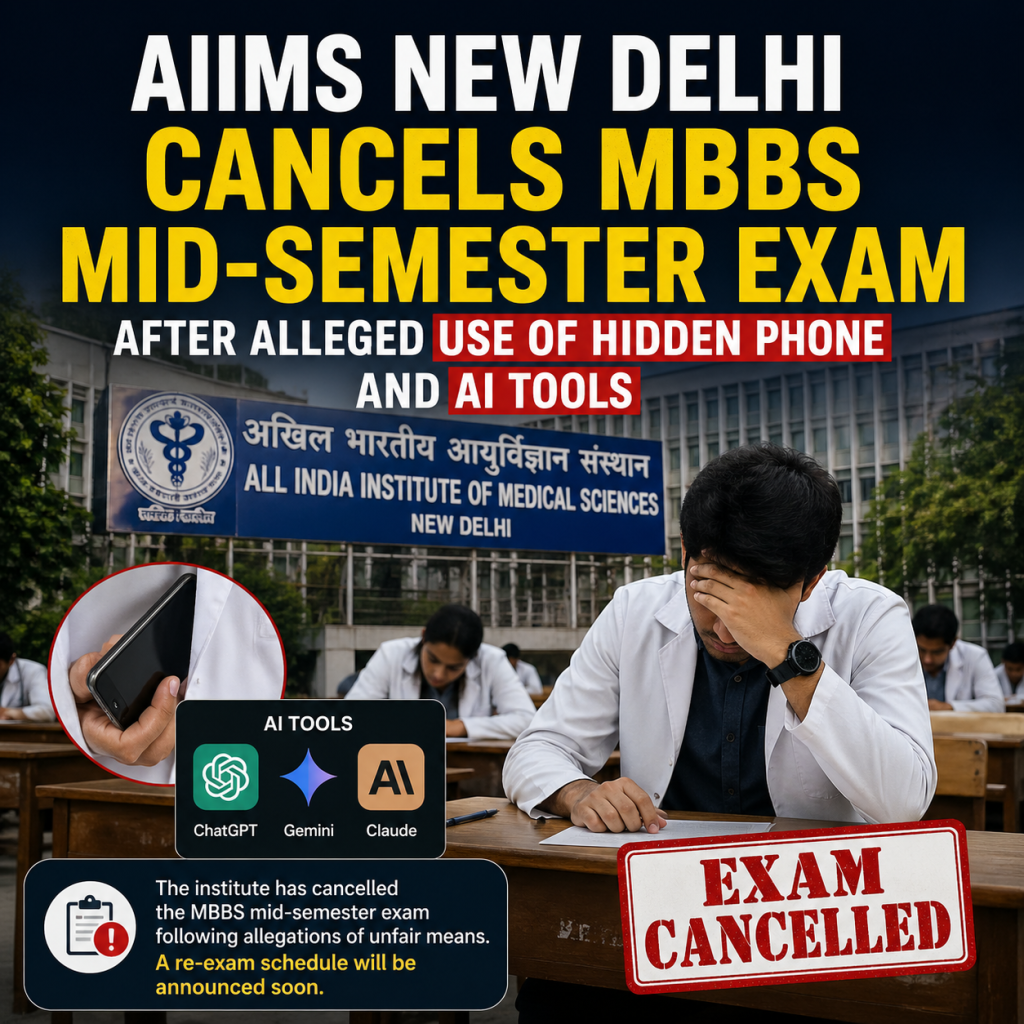
On April 24, 2026 reports emerged that AIIMS New Delhi had cancelled a mid semester MBBS biochemistry exam after faculty suspected students of using a cleverly hidden mobile phone in the restroom paired with AI chat tools to find answers during the test.
This isn’t just another exam day drama. It highlights a bigger shift happening in classrooms across the country: artificial intelligence is now part of the cheating toolkit and top tier institutes are scrambling to keep up. If you’re a medical student, parent, educator, or simply someone who cares about how our future doctors are trained, this story offers real insights into what’s at stake and what can be done about it.
What Exactly Happened at AIIMS New Delhi
The incident unfolded during a routine mid semester biochemistry paper for MBBS students. According to accounts shared with media outlets, invigilators started noticing something unusual: an unusually high number of students asking to leave the exam hall to use the restroom. At first, it might have seemed like nerves or too much water but the pattern raised red flags.
When staff checked the facilities, they discovered a mobile phone that had been left behind in the washroom area. Reports indicate that students had allegedly been taking turns accessing the device to query AI platforms such as ChatGPT for quick answers to questions appearing on their exam paper. One media report suggested that as many as 50 to 60 students could have been involved in this coordinated effort.
Mobile phones and any form of internet access are strictly prohibited inside AIIMS examination halls, as they have been for years. Yet in this case, students reportedly found a workaround by turning the shared restroom into a makeshift “digital help desk.” The phone itself wasn’t smuggled in during the exam; it appears one student left it there intentionally for others to use.
Dr. Reema Dada, media in charge at AIIMS New Delhi, confirmed the basics of the incident in a statement to journalists. She explained that “a student’s mobile phone was left in the toilet. The same mobile phone was used by other students.” As soon as the matter came to light, the administration was informed and acted quickly.
AIIMS Response: Swift Action but Measured Approach
In response, the institute made a decisive call: the entire biochemistry exam was cancelled on the spot and a re test was scheduled for the affected batch. This move ensured that no unfair advantage would carry forward into final assessments or future clinical rotations.
Notably as of the latest updates, no individual students have faced public disciplinary action beyond the exam cancellation. The focus seems to be on fairness for the group rather than immediate punishments though internal inquiries are likely ongoing. This balanced approach reflects the institute’s priority: maintaining academic standards without derailing an entire cohort’s progress unnecessarily.
For context, this isn’t an isolated event at AIIMS. Just weeks earlier, a second year MBBS student at AIIMS Rishikesh was caught during security checks trying to bring a phone into the hall hidden inside his slipper. That case also led to an investigation and highlighted how creative (and risky) some attempts at bypassing rules have become.
Why This Incident Matters More Than You Might Think
Medical training isn’t like other degrees. Future doctors deal with real human lives diagnosing illnesses, prescribing treatments and making split second decisions. Cheating in a biochemistry exam might seem like a shortcut to better grades, but it undermines the very foundation of competence that patients will one day rely on.
The use of AI here adds a new layer. Tools like ChatGPT can generate detailed explanations, solve complex problems and even mimic exam style answers in seconds. They’re incredibly powerful for legitimate learning helping students understand tough concepts, draft notes, or practice questions outside the exam hall but when brought into a closed book test, they cross a clear ethical line.
This story isn’t about shaming young adults under immense pressure. MBBS life is tough: long hours, vast syllabi and sky high expectations. Many students feel the system sometimes rewards rote learning over true understanding. Yet incidents like this remind us that shortcuts can have ripple effects on personal integrity, institutional reputation, and ultimately, public trust in the medical profession.
Rise of AI-Assisted Cheating: A Growing Challenge Across Education
We’re seeing similar stories pop up not just in medical colleges but in engineering entrances, competitive exams and even school boards. Students are getting smarter about tech, while many institutions are still catching up with basic phone bans and manual frisking.
Practical example: Imagine a student who’s struggling with a particular metabolic pathway in biochemistry. Instead of reviewing notes the night before, they (allegedly) snap a photo of the question in the restroom and let AI spit out a ready-made answer. It feels efficient in the moment but it skips the deep learning that comes from wrestling with the material yourself.
On the flip side AI also offers huge opportunities when used right. Some medical schools are already experimenting with open book AI allowed assessments that test critical thinking rather than memory. Others use AI proctoring software that flags suspicious behavior in real time.
Practical Tips for Students: Building Real Skills in the AI Era
If you’re preparing for medical exams right now, here’s some straightforward advice that actually helps long term:
- Treat AI as a study buddy, not a crutch. Use it to explain concepts you don’t get, generate practice questions, or quiz yourself. But always verify the output against your textbooks or professor’s notes AI can hallucinate facts.
- Practice active recall. Close the books (and the apps) and force yourself to write out answers from memory. This is what sticks during real clinical scenarios.
- Focus on understanding over memorization. Biochemistry isn’t just pathways to rote-learn; it’s about how the body works. Connect it to real patient cases you read about.
- Build ethical habits early. The pressure only gets higher in residency and practice. Starting with integrity now pays off when patients’ lives are on the line.
Actionable Steps for Colleges and Exam Authorities
Institutions aren’t powerless. Here are some proven and emerging strategies that could prevent future incidents:
- Enhanced physical security: Random sweeps, better restroom monitoring during exams, and full-body scanners where feasible (without invading privacy).
- Tech based proctoring: AI powered cameras that detect unusual movements or multiple people accessing the same area.
- Question design that resists AI: Shift toward application-based, scenario driven questions that require personal reasoning rather than facts AI can easily regurgitate.
- Clear policies with education: Hold orientation sessions explaining why rules exist, and offer support systems for stressed students instead of just punishment.
- Hybrid assessment models: Combine traditional closed-book tests with open resource practical evaluations that mirror real world doctoring.
Many top global medical schools have already moved in this direction, balancing rigor with fairness.
Short FAQ: Common Questions About the AIIMS Incident
Q1: Were all students in the exam involved?
Not necessarily. Reports point to around 50-60 students possibly using the setup, but the exact number is still under review. The entire batch’s exam was cancelled to ensure fairness.
Q2: Will the students face suspension or other punishments?
As of now, the primary consequence is the re-exam. AIIMS has not publicly announced individual penalties, focusing instead on rescheduling. Internal disciplinary processes may follow.
Q3: How common is AI cheating in Indian medical exams?
It’s emerging as a trend with the easy availability of tools like ChatGPT. Similar cases have surfaced in other competitive exams, but this one stands out because of the scale and the prestige of the institute involved.
Q4: Can AI actually help medical students prepare better?
Absolutely, when used ethically outside exams. It excels at breaking down complex topics, creating mnemonics or simulating patient interactions.
Q5: What should parents or aspiring doctors take away from this?
Integrity matters more than a single exam score. True success in medicine comes from genuine knowledge and ethical decision making.
Looking Ahead: Time for Reflection and Reform
This incident at AIIMS New Delhi isn’t the end of the world for the students involved, nor does it define the thousands of honest, hardworking MBBS learners across the country but it does serve as a timely wake up call.
As AI becomes smarter and more accessible, the rules of assessment need to evolve too. We can’t simply ban phones forever and hope for the best. Instead, educators, students and policymakers should work together to create systems that test real understanding while embracing technology responsibly.
For anyone reading this whether you’re currently grinding through MBBS, guiding the next generation or just following education news take a moment to reflect. What kind of doctors do we want? Ones who know how to game the system, or ones who know how to heal it?
The re exam at AIIMS will give these students a fresh start. Let’s hope it also sparks a broader conversation about building a medical education system that’s as advanced, ethical and human centered as the profession it serves.
What are your thoughts on AI in exams? Have you seen similar pressures in your own studies? Share in the comments below let’s keep the discussion going constructively.
Disclaimer
This post is for informational and educational purposes only. It does not constitute medical advice, legal opinion or an official investigation. Readers should consult qualified healthcare professionals for personal health concerns. All details are drawn from media reports and outcomes of any official inquiry may provide further clarity.
Link: According to reports from Medical Dialogues
https://medicaldialogues.in/amp/mdtv/healthshorts/aiims-delhi-cancels-mbbs-exam-after-students-allegedly-used-ai-to-cheat-169351