Chandigarh Consumer Commission ordered Healing Hospital, gastroenterologist, neuromedicine specialist and plastic surgeon to pay ₹50 lakhs after a routine IV cannula led to compartment syndrome, gangrene and amputation of four fingers. The patient suffered 85% permanent disability. The judgment exposes serious lapses in hospital monitoring and patient safety.
A Routine Hospital Admission That Ended in Permanent Disability
In a disturbing case highlighting how even a routine medical procedure can turn into a life-altering tragedy, the District Consumer Disputes Redressal Commission, Chandigarh, has ordered Healing Hospital and its treating doctors to pay ₹50 lakhs compensation to a 45-year-old woman whose healthy left hand developed gangrene after IV cannulation and ultimately required amputation of four fingers. The Commission held the hospital and the treating gastroenterologist, neuromedicine specialist, and plastic surgeon guilty of medical negligence and deficiency in service.
Why the Patient Was Admitted to Healing Hospital
The patient was admitted to Healing Hospital on 25 November 2020 with complaints of vomiting, headache, backache, and stomach pain. She was diagnosed with a gastrointestinal infection and started on intravenous antibiotics, antiemetics, PPIs, and painkillers. For administering these medicines, an IV cannula was inserted into her left forearm. At the time of admission, her left hand and arm were completely normal and healthy.
The First Warning Signs After IV Cannulation
Over the next two days, while her gastric symptoms improved, swelling started developing in her left hand. By 27 November 2020, the swelling had become noticeable, and the cannula was removed and inserted into the right hand. Despite this, pain in the left hand continued to increase. On the night of 28 November, the pain became severe, and by the next morning, the hand had turned bluish and numb, clearly indicating a serious vascular complication.
Sudden Deterioration and Emergency Surgery
On 28 November 2020, the patient’s condition worsened dramatically. She developed severe pain, bluish discoloration of the skin, mottling, and signs of reduced blood supply to the hand. The doctors suspected a limb-threatening condition and decided to perform emergency surgery. The patient and her family were informed about the seriousness of the situation and the risk of gangrene and possible amputation, and consent was obtained.
What Was Found Inside the Operation Theatre
During surgery, the doctors found tense compartments in the hand and forearm, darkened muscles, thrombosed superficial veins, and absent arterial pulsations. These findings were consistent with advanced compartment syndrome and severe vascular compromise. A fasciotomy was performed, and the patient was shifted to the ICU and started on further supportive treatment including anticoagulation.
The Next Day and Worsening Ischemia
On 29 November 2020, despite surgery, bluish discoloration again appeared in the fingers, indicating persistent and worsening compromise of blood supply. The doctors noted pre-gangrenous changes and the risk of complete tissue death. At this stage, the decision was taken to refer the patient to PGIMER, Chandigarh, for higher-level care.
The Shocking Sunday Referral With an Open Wound
One of the most disturbing aspects of the case was that the patient was referred to PGI on a Sunday, in the middle of treatment, with an open surgical wound, without proper closure or adequate dressing. The family protested, fearing lack of availability of senior doctors due to the weekend. Photographs later produced before the Commission showed the patient being transported with a visibly open wound, clearly establishing unsafe and incomplete transfer of a critically ill patient.
What Happened at PGIMER Chandigarh
At PGIMER, the emergency team attempted further treatment and involved vascular and plastic surgery specialists. Despite all possible efforts, the damage to the hand had already become irreversible. Ultimately, four fingers of the patient’s left hand had to be amputated, and skin grafting was performed. She remained under treatment for several weeks and was finally discharged in December 2020.
The Permanent Disability and Its Life-Long Impact
In September 2021, the competent medical authority assessed the patient’s permanent disability at 85 percent. The Commission noted that the patient was left-handed and a homemaker, and due to the loss of fingers, she is no longer able to perform basic daily activities independently, write, or handle routine documentation. The injury has resulted in permanent functional, psychological, and social impairment.
What Is Compartment Syndrome and Why It Is a Medical Emergency
Compartment syndrome is a condition in which pressure builds up inside closed muscle compartments, usually due to bleeding, swelling, or leakage of fluids into tissues. This pressure cuts off blood supply to muscles and nerves. If not treated immediately, it leads to irreversible muscle death, nerve damage, and ultimately gangrene. In this case, the Commission observed that failure to properly monitor the IV cannula site and delay in responding to early warning signs allowed compartment syndrome to develop and progress.
How Gangrene Develops After Loss of Blood Supply
Gangrene occurs when body tissues die due to prolonged loss of blood supply or severe infection. Once tissues remain without oxygen for several hours, the damage becomes irreversible. In this patient, prolonged vascular compromise of the hand and forearm following IV cannulation led to tissue death, gangrene of the fingers, and finally amputation.
Why the Consumer Commission Held Healing Hospital and Doctors Negligent
The Commission clearly noted that the standard protocol for IV cannula care requires regular monitoring for pain, swelling, discoloration, and vascular compromise. In this case, the cannula remained in place despite clear warning signs, and timely decisive intervention was lacking. The patient entered the hospital with a healthy hand and left the treatment chain with amputated fingers. The burden was on the hospital to prove that this did not occur due to their negligence, and the hospital failed to discharge this burden.
The Final Compensation Awarded and Who Was Held Responsible
After examining the entire medical record, photographic evidence, and disability certificate, the District Consumer Disputes Redressal Commission, Chandigarh, held Healing Hospital and its treating doctors namely the gastroenterologist Dr. Sandeep Pal, the neuromedicine specialist Dr. J.P. Singhvi, and the plastic surgeon Dr. Maninder Kaur Bedi jointly and severally guilty of medical negligence and deficiency in service. The Commission observed that the patient had entered Healing Hospital with a completely healthy left hand and that the catastrophic outcome of gangrene and amputation occurred entirely during the course of treatment under their care. Taking into account the permanent disability of 85 percent, lifelong functional loss, physical and mental suffering, and future rehabilitation needs including the cost of a bionic hand, the Commission awarded a lump sum compensation of ₹50 lakhs, payable within 45 days, failing which Healing Hospital, the gastroenterologist, the neuromedicine specialist, and the plastic surgeon shall be liable to pay interest at 9 percent per annum until realization.
A Clear Timeline of Medical Events
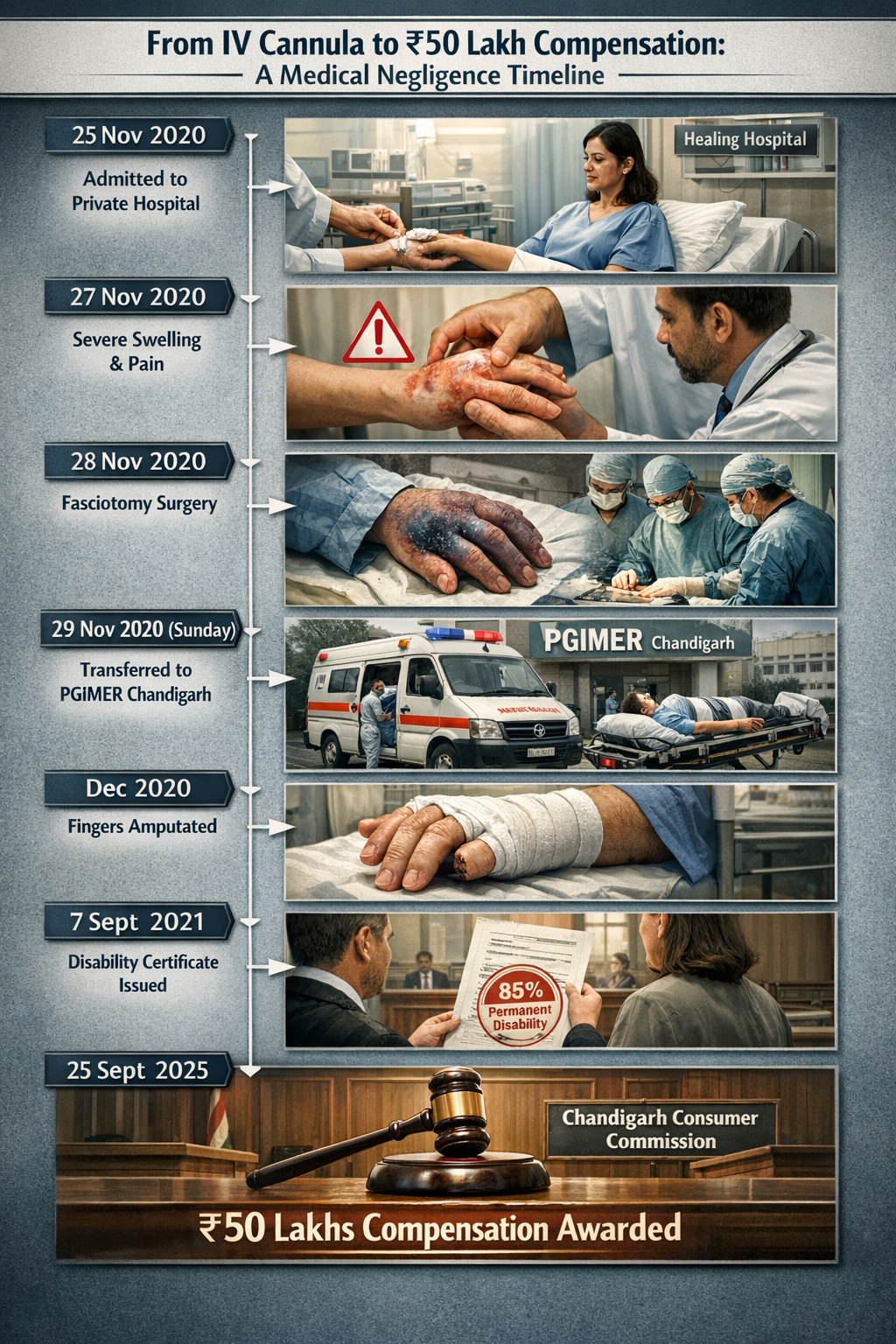
The patient was admitted to Healing Hospital on 25 November 2020 for gastric illness and underwent IV cannulation in the left hand. By 27 November 2020, swelling had appeared in the left hand. On 28 November 2020, severe pain, discoloration, and signs of vascular compromise developed, following which emergency fasciotomy was performed. On 29 November 2020, worsening ischemia and pre-gangrenous changes were noted, and the patient was referred to PGIMER, Chandigarh on a Sunday, with an open surgical wound. Despite further treatment at PGI, four fingers had to be amputated, and she remained under treatment until discharge in December 2020. On 7 September 2021, the competent medical authority assessed her permanent disability at 85 percent. After prolonged legal proceedings, the District Consumer Disputes Redressal Commission, Chandigarh passed the final judgment on 25 September 2025, holding Healing Hospital and its doctors guilty of medical negligence and awarding ₹50 lakhs compensation to the patient.
Legal and Clinical Takeaway for Doctors, Staff, and Hospitals
This case sends a strong message that there are no minor procedures in medicine. IV cannulation, though routine, can cause devastating complications if not monitored properly. Any complaint of pain, swelling, or discoloration at a cannula site must be treated as a red alert.
Hospitals must ensure strict monitoring protocols, early escalation systems, proper documentation, and safe patient transfers. Referring a critically ill patient on a Sunday with an open surgical wound and incomplete treatment is not only medically unsafe but also legally indefensible.
For nursing staff and junior doctors, this judgment reinforces that vigilant monitoring and early reporting of complications is a legal and ethical duty. For hospital administrations, it is a reminder that system failures and casual attitudes towards complications can result in irreversible patient harm and massive legal liability.
Uttar Pradesh introduces a major medico legal reform allowing post mortems in government and approved private medical colleges under the leadership of Brajesh Pathak. The policy aims to reduce delays, improve forensic training, enhance transparency and strengthen justice delivery across Uttar Pradesh.
Dramatic rise in C-section deliveries in India, now over 27% in 2024-25 A fourfold increase in 16 years. This blog dives into government data, reasons like private sector incentives and patient preferences, health risks, and solutions for balanced maternity care.
Medico-legal landscape of euthanasia in India, focusing on passive euthanasia and advance directives (living wills). From landmark Supreme Court rulings like Aruna Shanbaug (2011) and Common Cause (2018 & 2023) to patient autonomy and ethical considerations in end-of-life care.