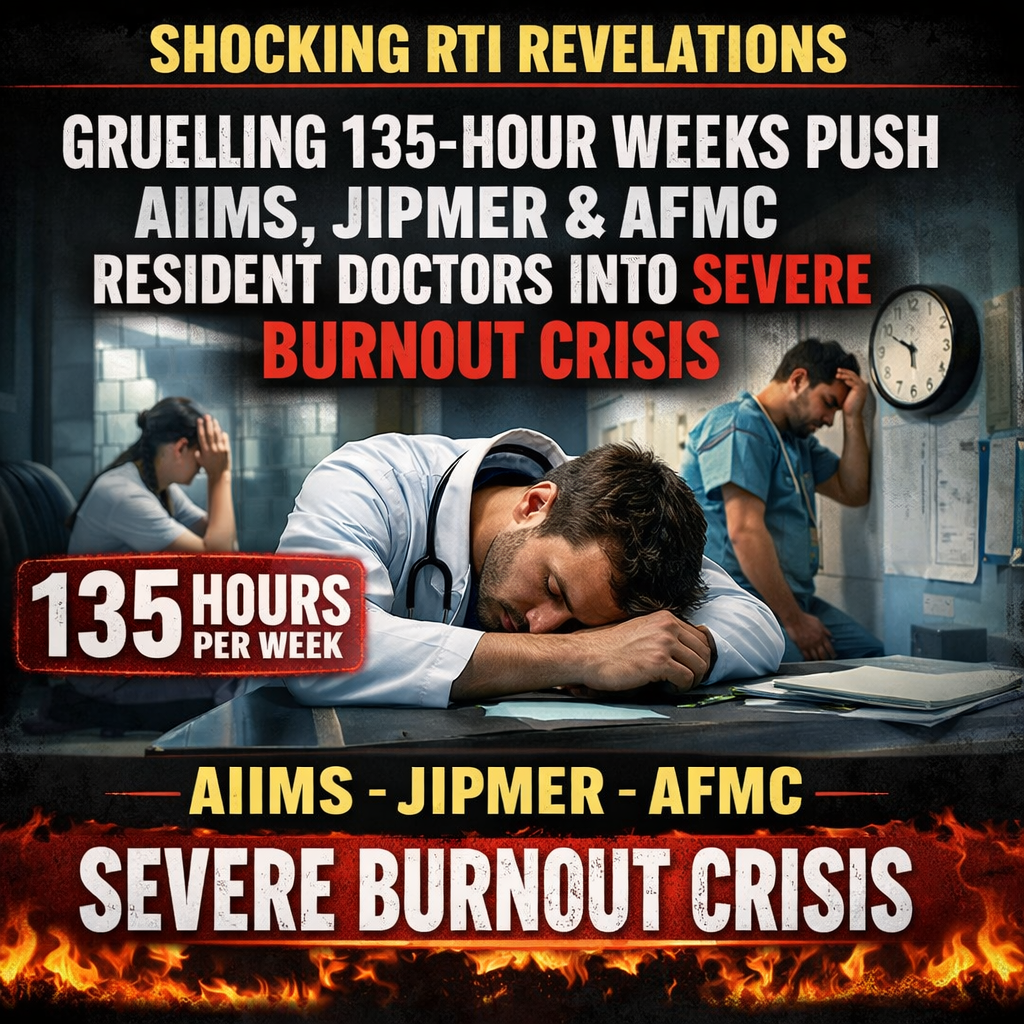
The findings paint a disturbing picture of 24 to 36 hour continuous shifts, weekly workloads exceeding 100 hours, skyrocketing burnout rates and a mental health crisis that’s driving talented young doctors to quit midway through their training.
As someone passionate about healthcare equity and doctor welfare, I believe this isn’t just “the way things have always been.” It’s a systemic failure that affects not only the doctors themselves but also the millions of patients who rely on them. Let’s break down what the RTI uncovered and why this matters for India’s future in medicine.
What the RTI Data Actually Reveals
The RTI applications, filed by activist J. Swamidass in collaboration with the United Doctors Front (UDF), sought straightforward answers: How many hours are resident doctors actually working? How often do they get rest? And what’s the toll on their mental health?
Responses were eye opening:
- AIIMS Nagpur: In the Paediatrics Department, junior residents logged a staggering 540 hours per month (roughly 135 hours per week) in August and September 2025. That’s the equivalent of working non stop for over five and a half days straight every single week. Anaesthesiology residents there faced 328 hours in a single month, including multiple 24 to 36 hour shifts.
- AFMC (Pune): Anaesthesiology residents endured 24–36 hour duties four to five times a month. One batch in 2024 handled 63 separate 36 hour shifts over just three months, plus frequent 12 hour night shifts.
- AIIMS Bhubaneswar: Despite official claims of capping duties at 48 hours weekly, departments like Ophthalmology routinely assigned 12–14 hour shifts with extensions up to 24–36 hours multiple times per week, depending on patient load.
- JIPMER: Many departments admitted they don’t even maintain proper records of actual duty hours or weekly offs raising serious questions about transparency. Between 2020 and 2024, 276 PG students quit the institute.
- NIMHANS: Residents get no night offs and only a half day off per week. Emergency duties stretch to 24 hours, 1–2 times monthly.
These numbers aren’t anomalies they reflect a pattern that violates the National Medical Commission’s own 1992 guidelines, which clearly state residents should not exceed 12 hours per day or 48 hours per week with mandatory weekly rest.
The Hidden Mental Health Toll
The RTI data doesn’t stop at hours worked it exposes the human cost. At AIIMS Delhi alone, 225 superspeciality students left their courses in the last three years. Student Wellness Centre records show hundreds of PG students sought psychiatric counselling between 2022 and 2024. JIPMER reported 12 PG students admitted to psychiatric wards for depression and stress related issues with another 200 seeking counselling. Complaints included “hectic workload,” “bullying by seniors” and “thesis related conflicts with faculty.”
Nationally, National Medical Commission acknowledged receiving 1,680 complaints about heavy workloads, long hours and harassment between 2020–2024. In the same period 1,113 PG medicos quit their courses and a heartbreaking 119 undergraduate and postgraduate medical students died by suicide.
Dr. Lakshya Mittal, Chairperson of the United Doctors Front, put it bluntly: “The alarming level of seat-leaving exposes the toxic work culture and inhumane duty hours.”
Why This Crisis Threatens Patient Safety Too
Exhausted doctors aren’t just suffering they’re at higher risk of medical errors. The recent Parliamentary Standing Committee on Health and Family Welfare (172nd report, March 2026) highlighted exactly this concern. Chaired by MP Prof. Ram Gopal Yadav, the panel noted massive faculty and resident vacancies leading to excessive workloads.
The committee explicitly recommended a “Clinical Duty Hours Regulation” policywith mandatory rest periods and monitored rosters drawing a direct parallel to safety critical professions like civil aviation, where fatigue management is non negotiable.
Fatigue induced mistakes in high pressure environments like emergency wards or operating theatres can have life altering consequences. When doctors are pushed beyond human limits everyone loses.
A Call for Urgent Reform
This isn’t the first time the issue has been raised. The United Doctors Front has already filed a Public Interest Litigation in the Supreme Court demanding enforcement of the 1992 duty hour rules. They’ve also written to Union Health Minister Shri J.P. Nadda urging immediate implementation of the Parliamentary recommendations.
The good news? Awareness is growing. Medical associations, resident doctors and even lawmakers are finally shining a light on what has long been an open secret in Indian medicine.
What Needs to Change and How You Can Help
Real solutions aren’t complicated, but they require political will:
- Strict enforcement of 48 hour weekly capswith mandatory 24 hour off periods.
- Proper record keepingof duty hours across all departments.
- Increased staffingto reduce individual workload.
- Robust mental health supportwith confidential counselling and reduced stigma.
- Regular auditsand transparent reporting to the National Medical Commission.
The RTI has given us the data. Now it’s time for action. India’s healthcare system can only be as strong as the doctors who hold it together. Let’s make sure we’re not burning them out before they even begin their careers.
What do you think? Have you or someone you know experienced this reality in medical training? Share your thoughts in the comments below I’d love to hear from you.
Stay informed. Stay compassionate and let’s keep pushing for a healthier future for doctors and patients alike.