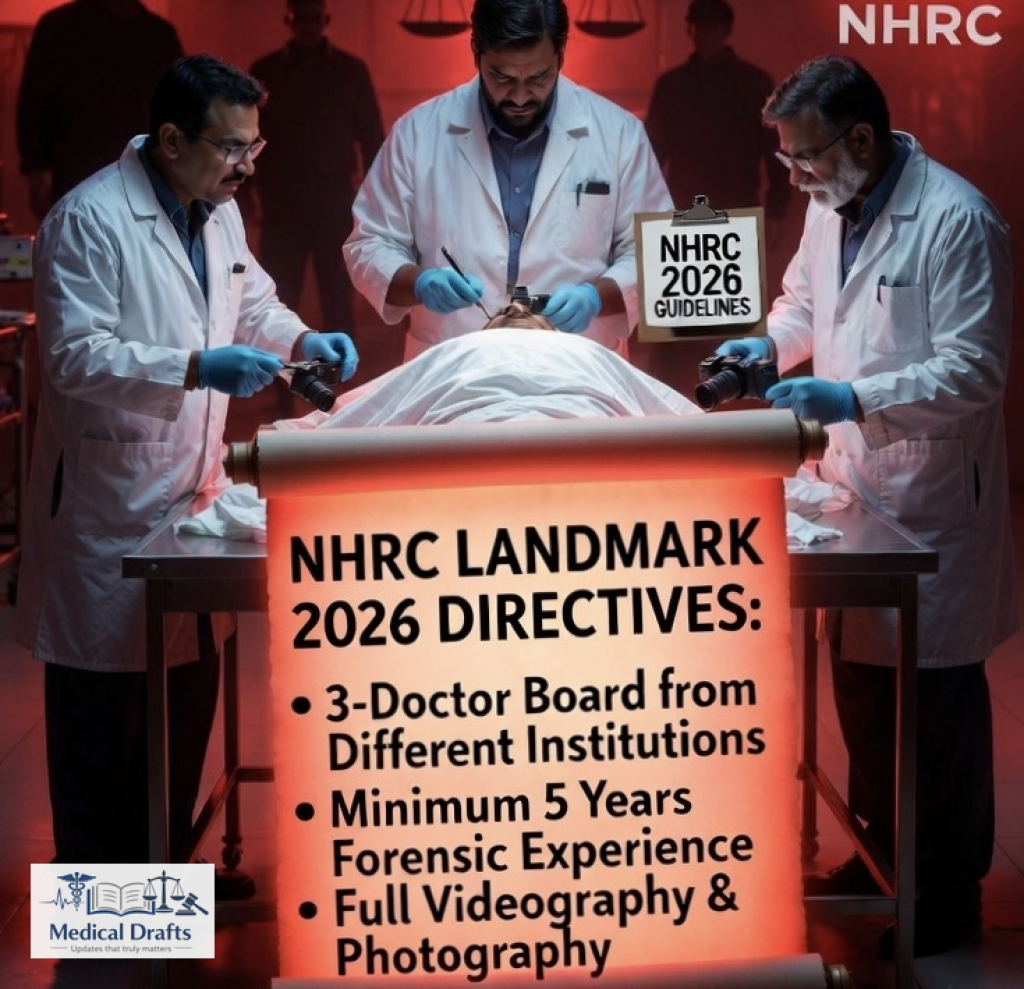
In a significant move aimed at restoring public faith in the justice system, National Human Rights Commission (NHRC) has issued fresh directives for conducting post mortem examinations in custodial death cases. Issued in March 2026, these guidelines mandate a team based approach with highly qualified forensic experts to ensure impartiality and scientific accuracy.
This development comes at a time when custodial deaths continue to raise serious questions about police accountability and human rights protections across the country. For citizens, legal experts and human rights advocates, these new rules represent a much needed step toward preventing cover ups and delivering justice.
Understanding Custodial Deaths: A Persistent Challenge in India
Custodial deaths occurring while a person is in police or judicial custody have long been a sensitive issue in India. According to recent data presented in Parliament, country recorded 170 custodial deaths between April 2025 and mid March 2026 alone. While not every case involves foul play, lack of transparent investigations has often led to allegations of torture, negligence or suppression of evidence.
Post mortem report is often the most critical piece of evidence in such cases. Yet, historically many autopsies have been conducted under pressure, by underqualified staff or within the same institution where external influences could compromise objectivity. Families of victims and human rights organizations have repeatedly highlighted discrepancies in autopsy reports, leading to prolonged legal battles and eroded trust in the system.
NHRC as India’s apex human rights body, has been addressing these gaps for decades through guidelines on videography of autopsies and model proformas. The latest directive builds on those efforts with stricter more practical standards.
What Do the New NHRC Guidelines Actually Say?
The March 2026 directive, communicated to all states and union territories, focuses on two core requirements for custodial death autopsies:
- Team of Experts from Multiple Institutions: Every post mortem must now be performed by a board of at least three doctors, preferably drawn from three different medical institutions. The reasoning is straightforward and powerful: doctors working in the same hospital or department may face internal pressure from senior colleagues, potentially affecting their professional judgment.
- Mandatory Qualifications and Experience: All doctors involved must hold a postgraduate degree in forensic medicineand possess at least five years of hands-on experiencein conducting post-mortem examinations.
These rules apply specifically to deaths in police or jail custody. States have been asked to review their current procedures and submit action taken reports to the NHRC within tight deadlines.
Guidelines were triggered by recent high profile cases in Tamil Nadu’s Sivaganga district involving the custodial deaths of Ajith Kumar and Akash Delison. Independent forensic reviews revealed serious lapses in earlier autopsies, prompting the NHRC to act swiftly and uniformly across the country.
Why These Changes Matter: The Human and Legal Impact
Imagine a scenario where a family loses a loved one in custody. The only way to uncover the truth is through, unbiased autopsy. If that process itself is flawed due to inexperience, institutional pressure or shortcuts justice becomes nearly impossible.
The new guidelines address exactly these vulnerabilities:
- Reducing Bias and Pressure: By requiring doctors from different institutions, the NHRC minimizes the risk of “senior influence” within a single medical college or hospital setup.
- Raising Professional Standards: Insisting on postgraduate forensic medicine qualifications and five years of experience ensures that only trained specialists handle these sensitive cases. This is a game changer in smaller districts where general doctors have often been tasked with complex medico-legal autopsies.
- Enhancing Credibility in Court: High quality, multi expert reports are far more likely to withstand legal scrutiny, helping both prosecution and defense present evidence based arguments.
These measures align with broader international standards, such as the Minnesota Protocol on the investigation of potentially unlawful deaths which India has referenced in its human rights commitments.
Recent Triggers: Lessons from Tamil Nadu Cases
The Sivaganga incidents in early 2026 exposed critical weaknesses in the existing system. Forensic experts flagged major discrepancies in the initial autopsy reports including missing documentation of injuries and failure to follow NHRC-prescribed formats. The cases gained national attention with one even leading to a CBI probe.
In response, Tamil Nadu government’s Health and Family Welfare Department promptly circulated the NHRC directive to medical education authorities asking for compliance reports by March 23, 2026. This rapid state level action shows how targeted interventions can drive nationwide reform.Such cases are not isolated. Across India, reports from the NHRC and civil society groups have repeatedly pointed to issues like “copy-paste” autopsy reports, delayed procedures and lack of videography despite earlier mandates.
Broader Implications for India’s Justice and Police Reforms
The NHRC’s move is part of a larger push for police and prison reforms. The Supreme Court and various high courts have emphasized the need for independent oversight in custodial matters. Key complementary measures already in place include:
- Mandatory videography of post mortems in custodial cases.
- 24 hour reporting of every custodial death to the NHRC.
- Use of the NHRC’s detailed model autopsy proforma.
When fully implemented, these guidelines could significantly reduce the impunity gap. Disciplinary action against erring officials has been rare in the past only a handful of cases in recent years despite hundreds of deaths. Better forensic evidence can change that equation.
For the medical community, directive also serves as a professional safeguard. Qualified forensic doctors will now have clearer roles and protection from undue pressure.
Challenges Ahead: Implementation Is Key
While the guidelines are welcome, success will depend on ground level execution. Some potential hurdles include:
- Shortage of Forensic Experts: Many states, especially in rural areas, face a severe shortage of postgraduate forensic medicine specialists.
- Infrastructure Gaps: Smaller government hospitals may struggle to assemble multi-institution boards quickly.
- Coordination Between Agencies: Police, prisons, health departments, and medical colleges need seamless collaboration.
To overcome these, states could invest in forensic medicine training programs, create dedicated panels of empaneled experts, and allocate budgets for timely travel and documentation. Civil society and media also have a role to play tracking compliance and highlighting best practices or lapses.
A Step Forward for Human Rights and Public Trust
The NHRC’s 2026 directives on custodial death autopsies are more than bureaucratic instructions they are a commitment to dignity, truth and accountability. In a democracy, no death in custody should go unexamined, and no examination should be compromised. By insisting on expert teams and rigorous qualifications, the Commission has sent a clear message: the process of uncovering truth must itself be transparent and tamper proof.
As citizens, we must stay informed and support institutions working toward these reforms. Families who lose loved ones in custody deserve nothing less than the highest standards of investigation. With consistent implementation, these guidelines can become a cornerstone of a more just and humane criminal justice system.
This post was written based on official NHRC communications and recent reports from March–April 2026. Always refer to the latest updates from the NHRC or state health departments for implementation details.
Also read NHRC guidelines: https://nhrc.nic.in/flipbook/act_rule_sop_guideline/70#flipbook-flipbook_book/1/