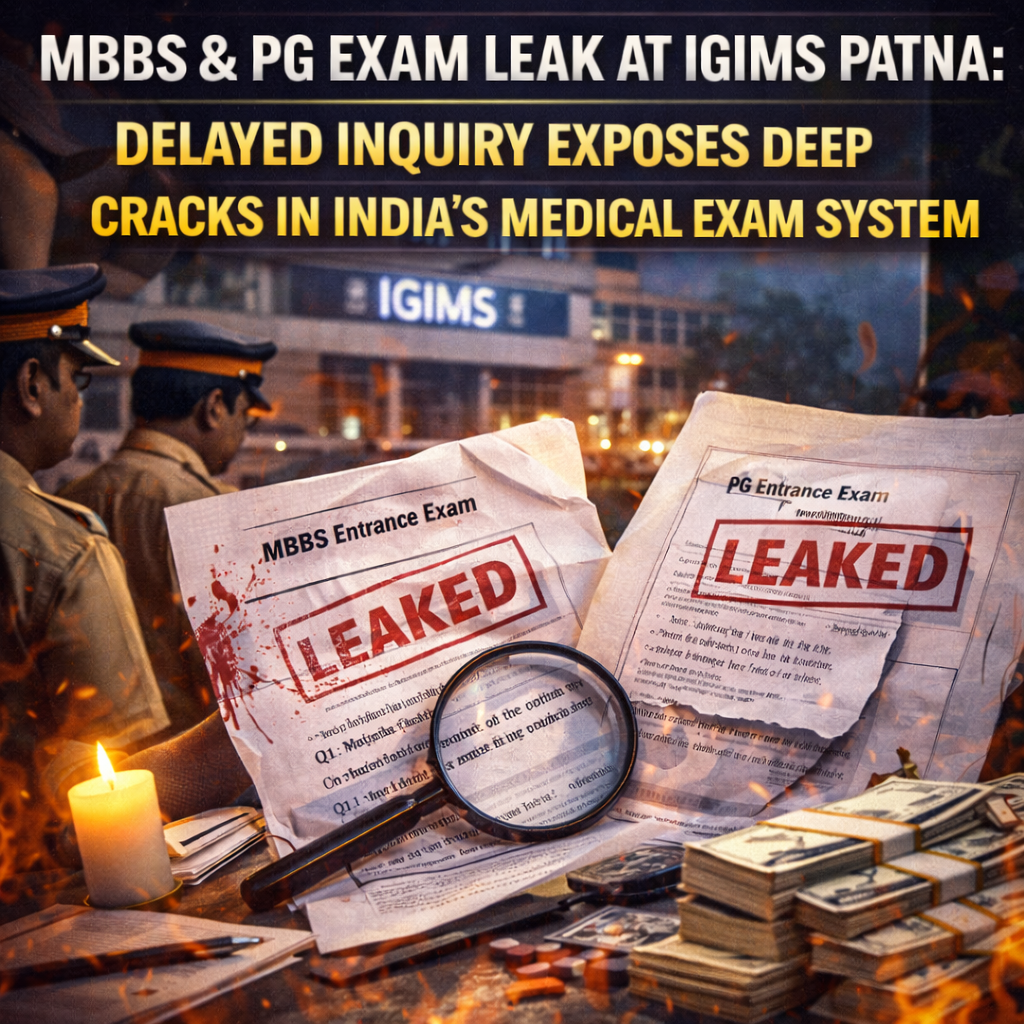
What makes this case particularly troubling? Complaint surfaced on March 13, 2026via an anonymous email. Yet it took the institute nearly one full monthto constitute a probe committee. For thousands of medical students whose careers hang in the balance, this delay feels like justice delayed and possibly denied.
As someone who follows medical education closely, this isn’t just another “paper leak” headline. It strikes at the very foundation of trust in India’s doctor training system. In this blog post, we break down what happened, why it matters and what urgent reforms are needed before the next batch of future doctors walks out with compromised credentials.
What Exactly Alleged at IGIMS Patna?
According to multiple reports, the anonymous email sent on March 13 flagged serious irregularities during the MBBS and PG final year exams. The allegations include:
- Question paper leaksbefore the exams
- Answer sheet manipulationand tampering
- External writing of answer sheetsthat were later inserted into the official system
- Large sums of money allegedly exchanged for these “services” with different rates fixed for paper leaks versus answer tampering
The institute’s Acting Dean, Dr. Om Kumar, finally constituted a four member inquiry committeeon April 11, 2026. The panel is headed by Dr. Sanjay Kumar, Head of the Department of Preventive and Social Medicine (PSM). Notably, institute’s Principal Dr. Ranjit Guhahas publicly claimed he was kept out of the loop regarding the committee’s formation.
IGIMS Patna is a prestigious autonomous medical college funded by the Bihar government. It trains hundreds of MBBS and PG students every year. When malpractice is alleged at such an institution, ripple effect goes far beyond Patna it shakes public faith in the entire medical education ecosystem.
Timeline of the IGIMS Controversy
- March 13, 2026→ Anonymous email lands with detailed allegations of exam malpractice.
- March–Early April 2026→ No visible action from the administration (students and parents reportedly growing restless).
- April 11, 2026→ Four-member probe committee finally announced.
- April 12, 2026 onwards→ Media coverage intensifies; students, doctors, and education activists demand transparency and swift action.
The delay has already sparked criticism. Why did it take 28–29 days for an institute of this stature to even acknowledge the complaint officially?
The Bigger Picture: Paper Leaks Are Not New But They’re Getting Worse
India has seen far too many high profile exam scandals in recent years from NEET UG leaks to state level recruitment paper leaks. Medical entrance and final year exams are especially vulnerable because:
- Huge stakes— A single MBBS or PG seat can decide a student’s entire career and earning potential.
- High monetary temptation— Middlemen and corrupt insiders see lakhs of rupees to be made.
- Weak digital security— Many institutes still rely on outdated printing and distribution methods for question papers.
When final year MBBS and PG exams are compromised, it doesn’t just affect one batch. It questions the competence of doctors who will soon treat patients. Would you want a surgeon whose final exam answers were written by someone else?
How This Affects Students, Parents, and the Healthcare System
For honest students:The most heartbreaking part. Hardworking students who spent years burning the midnight oil now wonder if their degrees will carry the same value. The shadow of doubt falls on everyone.
For parents:Many have taken huge education loans or sold assets to fund medical education. They expect iron clad fairness not a system where money can allegedly buy grades.
For the healthcare system:India already faces a doctor shortage in rural areas. If public trust erodes further, patients may hesitate to trust young doctors emerging from institutes involved in such controversies.
For IGIMS’s reputation:This is not the first time questions have been raised about examination processes at the institute. Earlier stakeholder letters had even questioned faculty competence and pass percentages. Repeated controversies can hurt future admissions and research funding.
What Should Happen Next? 5 Immediate Demands
As a responsible voice in the education space, here’s what I believe must follow:
- Complete transparency— The inquiry committee’s terms of reference, timeline and interim findings should be made public (without compromising the investigation).
- CCTV footage audit— All exam halls and strong rooms must be thoroughly reviewed.
- External oversight— Involving the Medical Council of India (NMC) or an independent anti corruption body would restore credibility faster.
- Stringent punishment— If proven, guilty parties (staff or students) must face exemplary action not just suspension.
- Systemic reforms— Digital question paper generation, biometric verification and blockchain based answer sheet tracking are no longer optional, they are essential.
Lessons for Every Medical College in India
The IGIMS Patna case is a loud wake-up call for every medical university and teaching hospital. Exam integrity is not a “nice to have” it is the bare minimum expected from institutions that produce life saving professionals. Students deserve better. Nation’s health deserves better.
If you are a medical student, parent, doctor or concerned citizen. now is the time to demand accountability. Share this post, tag your local representatives and keep the conversation alive. Fair exams are not a privilege they are a right.
What do you think?Should medical institutes facing such allegations be put under immediate NMC supervision? Drop your thoughts in the comments below. Let’s discuss solutions, not just problems.
This is an independent analysis based on publicly reported facts as of April 12, 2026. We will update this post as new developments emerge from the inquiry committee.