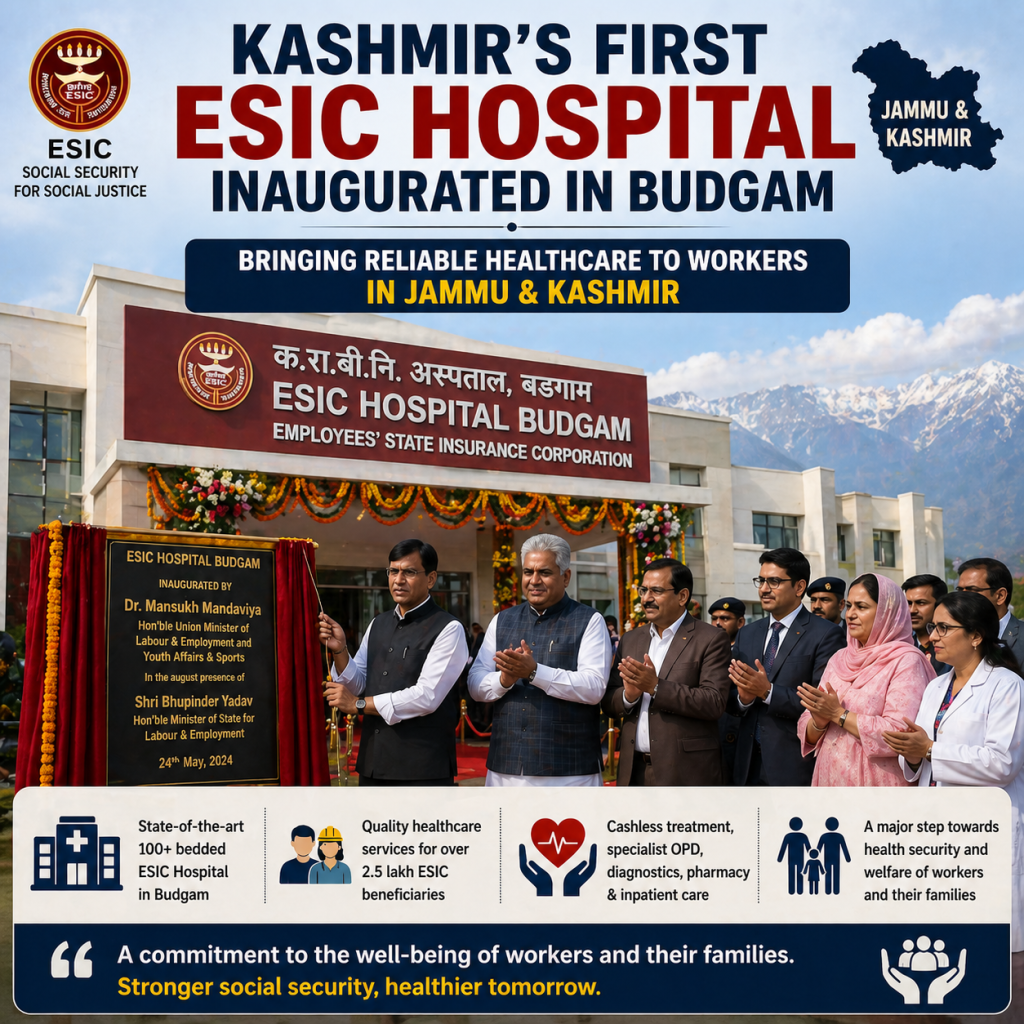
On April 24, 2026 Union Health Minister Dr. Mansukh Mandaviya inaugurated Kashmir’s very first ESIC hospital in the Ompora area of Budgam district. Standing on five acres of land and built at a cost of around ₹165 crore, the new 30 bed facility (with clear plans to scale up to 100 beds) marks a quiet but important shift in how healthcare reaches working people in Jammu and Kashmir.
For years many insured workers in the region had to travel long distances or rely on private options that often strained their finances. This hospital changes that equation. It brings modern medical facilities closer to home for thousands of families who contribute to the local economy every single day.
If you’re a worker, an employes or simply someone who cares about accessible healthcare in Kashmir, this development is worth understanding. In the sections below, we’ll walk through what happened at the inauguration, what the ESIC scheme actually offers, how the new hospital will work and most importantly practical steps you can take to make the most of these benefits.
Inauguration Ceremony: A Step Toward Worker Dignity
Event itself was straightforward and focused. Dr. Mansukh Mandaviya formally opened the hospital amid local officials and community members. In his address, the minister emphasized a core government priority: “A country that values the dignity of its workers is unstoppable on the path of progress.”
He highlighted how the facility aligns with broader efforts under Prime Minister Narendra Modi to strengthen social security for the workforce. Hospital is designed not just as a building but as a reliable support system for insured persons (IPs) and their families across the Kashmir Valley.
Local leaders also noted that the project reflects years of planning to address the gap in organized healthcare services in the region. With Budgam being a growing district with small industries, handicraft units and other employment pockets, the timing feels right.
What Exactly Is the ESIC Scheme?
Employees State Insurance Corporation (ESIC) is a government run social security program that has been running across India for decades. It works on a simple principle: both employers and employees contribute a small percentage of wages every month, and in return, workers get comprehensive medical coverage plus some cash benefits during tough times.
Eligibility is straightforward. If you work in a factory, shop, hotel, transport company or any establishment with 10 or more employees and earn up to ₹21,000 per month (the current wage ceiling), you and your family are covered. In Jammu and Kashmir alone, ESIC already covers around 1.83 lakh insured persons. Until now, though, the nearest full fledged ESIC hospital was far away for most people in the Valley.
The scheme kicks in from the very first day of employment. You don’t have to wait months to become eligible. Contributions are automatically deducted, and the medical card (often called the ESI card) gives access to cashless treatment at empanelled hospitals and now, right here in Budgam.
Spotlight on the New Budgam ESIC Hospital
The Ompora facility is modest to start with 30 beds but built with expansion in mind. It will initially focus on essential services like outpatient care (OPD), inpatient treatment, basic diagnostics, pharmacy and emergency services. As it grows to 100 beds, specialists in areas such as general medicine, surgery, pediatrics, gynecology and orthopedics are expected to be added.
What makes it practical is its location. Budgam is well connected and serves as a hub for surrounding areas. Workers from Srinagar outskirts, Ganderbal or even parts of Baramulla won’t have to undertake long, expensive journeys anymore for routine or even moderate medical needs.
Hospital also includes space for future academic programs such as a nursing college which could help address the shortage of trained healthcare staff in the region over time.
Why This Matters for Families in Kashmir
Healthcare access has long been a challenge in Jammu and Kashmir. Hilly terrain, seasonal disruptions and limited public facilities often mean people delay treatment or end up paying high out of pocket costs. For a daily wage worker or someone in a small workshop even a simple surgery or prolonged illness can wipe out savings.
Take the example of a typical handloom weaver or small factory supervisor in Budgam. Before this hospital a family member falling seriously ill might have meant borrowing money or skipping work for days while traveling elsewhere. Now, same family can walk into an ESIC facility knowing treatment is covered without worrying about immediate bills.
This reduces financial stress and encourages people to seek care early something doctors always recommend but is hard to follow when costs are high.
Key Benefits Under ESIC You Should Know About
Hospital is just one part of a bigger package. ESIC offers several benefits that go beyond hospital visits:
- Medical Benefits: Cashless treatment for you and your family (spouse, children, and sometimes dependent parents) at ESIC facilities or empanelled hospitals.
- Sickness Benefit: Up to 70-90% of daily wages for a maximum of 91 days in a year if you’re unable to work due to illness.
- Maternity Benefit: Paid leave and medical care for women workers for up to 26 weeks.
- Disablement Benefit: Long term support if an accident or occupational disease causes permanent disability.
- Dependants’ Benefit: Financial help for the family if the insured person passes away due to employment related causes.
These aren’t abstract promises. In practice, they mean a worker doesn’t lose everything when life throws a curveball.
How to Access ESIC Services: A Simple Step by Step Guide
Here’s the actionable part many people miss:
- Check if your employer is registered: Ask your HR or owner for the ESI registration number. Every covered establishment must register within 15 days of meeting the criteria.
- Get your ESI card: Once contributions start, you can apply for the Pehchan card through the ESIC portal (esic.gov.in) or the UMANG app. You’ll need your Aadhaar, bank details, and family information.
- Download the app: ESIC app or website lets you book appointments, view records, and find nearby facilities.
- Visit the hospital: Carry your ESI card or e-card. Treatment is cashless for covered services.
- Annual health check-ups: ESIC offers free preventive health checkups use them to catch issues early.
If you’re an employer, make sure deductions are made correctly and records are updated. It protects both sides and avoids penalties.
Addressing Healthcare Gaps in Jammu and Kashmir
The new hospital doesn’t solve every problem overnight. The region still faces issues like specialist shortages in remote areas and occasional seasonal pressures. But by starting in Budgam, authorities are building a foundation. Over time, more ESIC dispensaries and tie ups with private providers can expand the network.
This also encourages formal employment. When workers know they have reliable social security, it strengthens the local economy and reduces the burden on government general hospitals.
FAQ
1. Who is eligible for the new Budgam ESIC Hospital?
Any insured worker earning up to ₹21,000 per month in a covered establishment, plus their immediate family members. Coverage starts from day one of employment.
2. Is treatment completely free?
Yes, for medically necessary services at ESIC facilities. Some advanced procedures may have limits or require referral but core care is cashless.
3. What if I already have health insurance from my job?
ESIC is separate and complements other schemes. You can use it alongside private insurance in many cases.
4. How do I register if my employer hasn’t done it yet?
You can report it directly to the local ESIC office or through the portal. Employers are legally required to register eligible units.
5. Will the hospital have specialist doctors?
Initially, it will focus on general and basic specialty care. As it expands to 100 beds more specialists will be added.
Looking Ahead: A Foundation for Better Worker Security
The inauguration of Kashmir’s first ESIC hospital in Budgam is more than a ribbon cutting event. It’s a practical investment in the people who power local industries, tourism, handicrafts and small businesses.For workers and their families, it means peace of mind. For the region, it signals that social security is expanding where it’s needed most. The real success though will depend on how well people use it employers registering properly, workers staying informed and authorities ensuring smooth operations.
If you or someone in your family works in a covered job take a few minutes today to check your ESIC status. Download the app, get your card updated, and spread the word to colleagues. Small steps like these turn a new hospital into real, everyday protection. This development reminds us that steady, thoughtful progress in healthcare can make a genuine difference in people’s lives. Here’s hoping more such facilities follow building a stronger, healthier Jammu and Kashmir for everyone who calls it home.
Disclaimer
This post is for informational and educational purposes only. It does not constitute medical advice, legal opinion or an official investigation. Readers should consult qualified healthcare professionals for personal health concerns. All details are drawn from media reports and outcomes of any official inquiry may provide further clarity.
Link: According to reports from Greater Kashmir https://www.greaterkashmir.com/health/union-labour-minister-inaugurates-rs-165-crore-first-esic-hospital-in-kashmir-11763368/amp